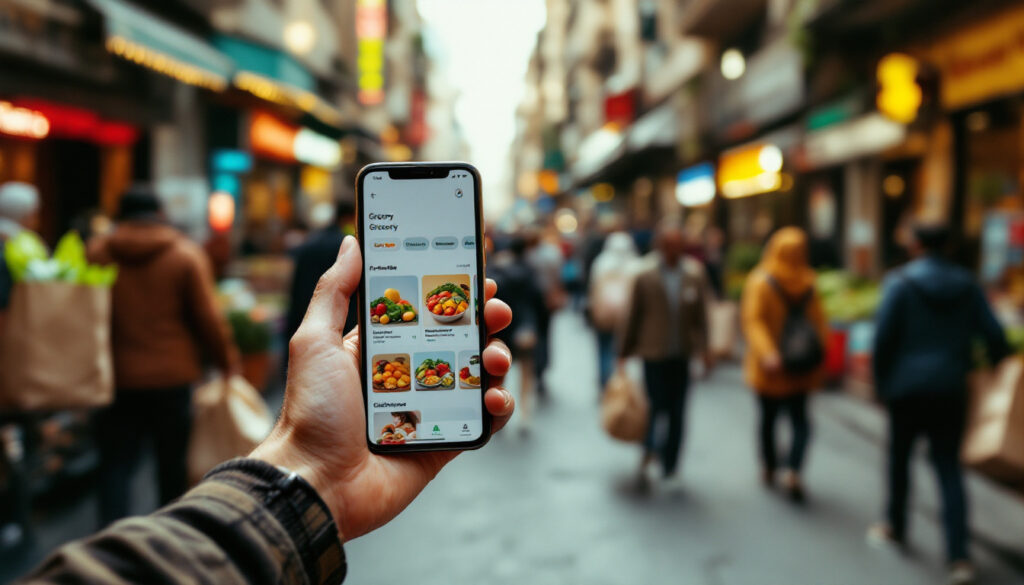
When a shopper opens a quick-commerce app, they are rarely browsing for entertainment. They are about to buy, often within minutes, and they are looking for the right product to add to a cart that is already on its way to checkout. That single fact makes quick commerce advertising one of the most efficient ways for a brand to reach a customer: visibility inside an instant-delivery app is visibility at the exact moment of purchase, in the exact place where the decision is made.
Key takeaways
- Quick commerce advertising places a brand in front of shoppers who are already committed to buying, which is why intent and timing make it uniquely effective compared with most awareness channels.
- The core formats are generic across instant-delivery apps: stronger search visibility, sponsored or featured placement in relevant aisles, and presence around seasonal or high-demand moments.
- Strong creative, accurate product content, and a clear measurement plan matter more than spend alone — the apps reward relevance, not just budget.
- The most common mistakes are treating in-app visibility like a billboard, ignoring out-of-stock and availability signals, and measuring vanity metrics instead of incremental sales.
What retail media and in-app visibility actually are
Retail media is advertising that happens inside a retailer’s own shopping environment — the app or site where customers actually transact. Instead of renting attention on social feeds or search engines and hoping it converts later, a brand earns visibility in the place where the purchase is completed. On a quick-commerce app, that environment is unusually concentrated: a shopper opens the app, searches or browses a handful of aisles, fills a basket, and checks out, frequently in a single short session.
Because the journey from intent to purchase is so compressed, in-app visibility behaves differently from traditional media. There is no long gap between seeing a product and being able to buy it. The shopper can act on a recommendation immediately, which means the value of being visible at the right moment is far higher than the value of being seen broadly.
Why instant delivery changes the equation
- Real-time relevance: what a customer wants on a hot afternoon, during a holiday, or late at night is highly contextual, and an instant-delivery app sees that context as it happens.
- Closed loop: the same environment that shows a product also records whether it was bought, so the path from visibility to sale is observable rather than inferred.
- Local precision: because fulfilment runs through neighbourhood dark stores, relevance can reflect what is genuinely available and popular in a specific area.
The formats that exist on quick-commerce apps
Across instant-delivery apps generally, brand visibility tends to take a few recognisable shapes. The labels differ from platform to platform, but the underlying mechanics are consistent.
Search visibility
When a shopper types a category or product term, the results they see shape what ends up in the basket. Earning stronger visibility against relevant searches — so a brand’s product appears prominently when someone looks for that category — is one of the most intent-rich placements available, because the shopper has explicitly signalled what they want.
Sponsored and featured placement
Beyond search, products can be surfaced in browse aisles, category pages, and curated areas of the app. A featured or sponsored placement gives a product additional prominence in a relevant context — for example, appearing near the top of the aisle where shoppers expect to find it. The key word is relevant: placement works when it matches what the shopper is already looking for, not when it interrupts an unrelated journey.
Seasonal and high-demand moments
Demand on quick-commerce apps spikes around predictable moments — holidays, weekends, weather events, and cultural occasions. Aligning visibility with these moments lets a brand show up when a category is already surging, amplifying natural demand rather than trying to create it from nothing. This is where understanding local shopping rhythms pays off, which is one reason it helps to study what quick-commerce data reveals about shoppers before planning a campaign.
Why intent and timing make it powerful
Most advertising spends heavily to manufacture intent — to make someone want a product they were not thinking about. Quick commerce advertising works in the opposite direction. The intent already exists; the job is to be the obvious choice at the moment it is acted on.
- Shorter path to purchase: there is no detour from inspiration to a separate store. The shelf and the checkout are the same surface.
- Higher relevance density: a shopper in a grocery aisle is a qualified prospect for grocery brands, with very little wasted reach.
- Compounding signals: the more a product proves it satisfies real demand, the more relevant it becomes to surface, creating a virtuous cycle for products customers genuinely like.
This dynamic is part of a broader shift in how instant delivery is reshaping retail across the region, a trend explored in the state of quick commerce in Egypt and MENA.
Creative and content best practices
Visibility only converts if the product itself is presented well. On a small screen, in a fast session, the product content does most of the persuading.
- Lead with clarity: clean product imagery, an accurate name, and a recognisable pack make a product instantly scannable in a crowded aisle.
- Get the fundamentals right: correct titles, descriptions, sizes, and categorisation help a product appear for the right searches and avoid disappointing shoppers.
- Respect the context: creative that suits an instant-delivery mindset — convenience, freshness, value, immediacy — tends to outperform messaging borrowed from long-form brand campaigns.
- Plan for the moment: tailor what you promote to the time of day, the season, and local preferences rather than running one message all year.
Strong content is also what makes a brand a good long-term partner to the platform, a relationship described in how Rabbit approaches empowering local suppliers and brands.
How to measure what matters
The advantage of advertising inside the store is that outcomes are observable. The discipline is choosing the right outcomes to watch.
- Focus on sales, not impressions: the point of in-app visibility is units sold and revenue, not how many times something was seen.
- Look for incrementality: the most useful question is whether visibility produced sales that would not have happened otherwise, rather than crediting purchases a shopper was already going to make.
- Watch efficiency over time: track how much visibility it takes to drive a unit of sales, and whether that ratio improves as creative and targeting are refined.
- Connect to availability: measurement is only honest when it accounts for whether a product was actually in stock and deliverable during the campaign.
Treat early campaigns as learning, not just spending. The closed-loop nature of the channel means each cycle should sharpen the next.
Common pitfalls to avoid
- Treating the app like a billboard: in-app visibility is a performance channel close to purchase, not a pure awareness buy — judge it by sales, not reach.
- Ignoring availability: promoting a product that is out of stock or slow to restock wastes visibility and frustrates shoppers.
- Neglecting product content: even prime placement underperforms when titles, images, or categorisation are weak.
- Chasing volume over relevance: showing up everywhere is less effective than showing up precisely where intent is high.
- Measuring the wrong thing: optimising for impressions or clicks instead of incremental sales leads to confident decisions built on the wrong signal.
Frequently asked questions
What is quick commerce advertising?
It is advertising that takes place inside an instant-delivery app, where brands earn visibility — through stronger search presence, sponsored or featured placement, and presence around high-demand moments — at the point where shoppers are actively buying. Because the app is both the shelf and the checkout, the advertising sits directly in the path to purchase.
Why is in-app visibility more effective than traditional ads?
Most advertising tries to create demand and then hopes it converts somewhere else later. In a quick-commerce app the shopper already intends to buy and can act immediately, so visibility lands at the moment of highest intent with very little wasted reach. The same environment also records the outcome, making results far easier to see.
How should a brand measure success?
Focus on sales rather than impressions, and look for incremental results — purchases that the visibility genuinely drove. Track how efficiently visibility converts into units over time, and always read the numbers alongside whether the product was in stock and deliverable during the campaign.
Curious how instant delivery turns shopper intent into real-time relevance? Discover how Rabbit works.